Types of traffic signs
There are 4 main types of road traffic signs
Add information about
Other
Prohibition signs (regulations)
Guide signs
Warning signs
Guide signs (instructions)
Auxiliary signs (supplementary information)
Gaimen Kirikae study guide
There are 4 main types of road traffic signs
Types of traffic signs
There are 4 main types of road traffic signs
Add information about
Other
Prohibition signs (regulations)
Guide signs
Warning signs
Guide signs (instructions)
Auxiliary signs (supplementary information)

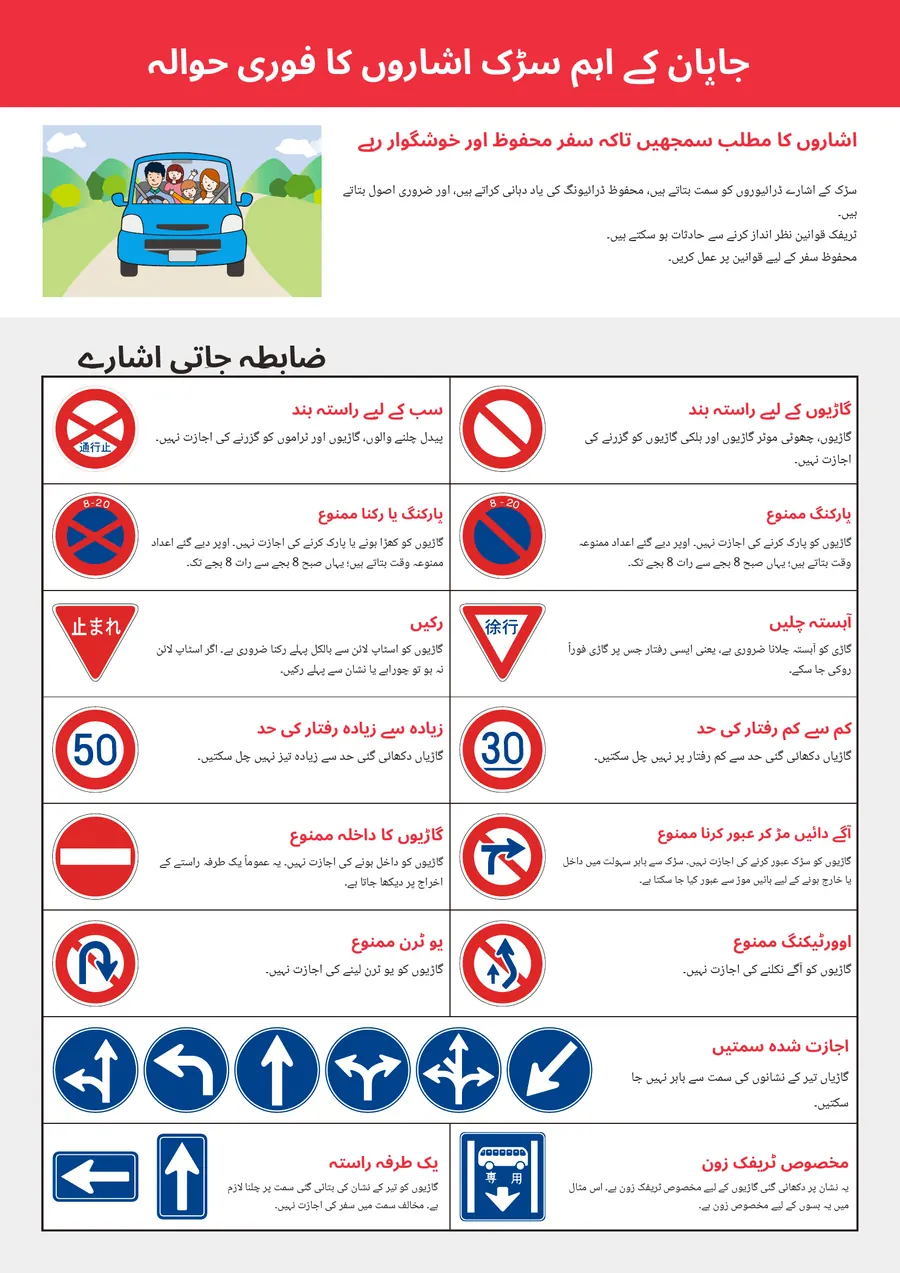
No passage is allowed for all pedestrians, vehicles, and trams.

Vehicles (automobiles, motorized bicycles, and light vehicles) are not allowed to pass.

Vehicles are not allowed to enter (often placed at the exit of one-way roads).

Motorcycles (large and standard motorcycles) are allowed to pass, but other vehicles are not.

Large cargo vehicles, large special vehicles, and specific medium cargo vehicles are not allowed to pass.

Cargo vehicles exceeding the maximum load indicated by the supplementary sign are not allowed to pass.

Large passenger vehicles and specific medium passenger vehicles are not allowed to pass.

Motorcycles (large and standard motorcycles) and motorized bicycles are not allowed to pass.

Light vehicles such as carts and handcars, except bicycles, are not allowed to pass.

Bicycles are not allowed to pass.

Vehicles indicated on the sign are not allowed to pass. In this case, automobiles and motorized bicycles are not allowed to pass.

Two-person riding on large and standard motorcycles is not allowed (except for those with sidecars).

Vehicles must not travel in any direction other than the one indicated by the arrow.

Vehicles must not cross (except for left turns to enter or exit facilities or places outside the road).

Vehicles are not allowed to make a U-turn.

Vehicles must not cross to the right side of the road to overtake (overtaking without crossing to the right side is allowed).

Vehicles are not allowed to overtake.

Vehicles are not allowed to park or stop (the numbers above indicate the prohibited time, in this case from 8 AM to 8 PM).

Vehicles are not allowed to park (the numbers above indicate the prohibited time, in this case from 8 AM to 8 PM).

Vehicles must not park unless there is the parking space indicated by the supplementary sign (in this case, 6 meters) on the right side of the vehicle.

Parking is allowed only during the indicated time, and parking beyond the time limit is prohibited (in this case, parking for more than 60 minutes between 8 AM and 8 PM is not allowed).

Vehicles carrying hazardous materials such as explosives, poisons, or toxic substances are not allowed to pass.

Vehicles exceeding the weight limit indicated on the sign are not allowed to pass. *Total weight includes the vehicle, passengers, and cargo.

Vehicles exceeding the height limit indicated on the sign are not allowed to pass (including the height of the cargo).

Vehicles exceeding the width limit indicated on the sign are not allowed to pass (including the width of the cargo).

Vehicles and trams must not exceed the maximum speed indicated on the sign. However, for motorized bicycles or vehicles towing others, if the speed indicated on the sign is higher than the legal speed limit, they must not exceed the legal speed limit.

Vehicles indicated on the supplementary sign must not exceed the speed indicated on the main sign.

Vehicles must not travel at a speed lower than the one indicated on the sign.

Indicates a highway or road exclusively for motor vehicles. Pedestrians, motorized bicycles, and light vehicles are not allowed to pass.

Indicates a bicycle path or bicycle-only road, where vehicles other than standard bicycles and pedestrians are not allowed to pass.

Indicates that only bicycles and pedestrians are allowed to pass. Vehicles other than bicycles are not allowed.

Indicates a pedestrian-only road or pathway designated for pedestrian passage. Vehicles are not allowed to pass (except with special permission).

Vehicles can travel in the direction indicated by the arrow. Travel in the opposite direction is not allowed.

A sign indicating the lane designation for vehicles, which must follow the designated lanes (in this case, for light vehicles and motorcycles).

Indicates the lane designation for specific vehicle types, where large cargo vehicles, specific medium cargo vehicles, and large special vehicles must use the leftmost lane.

Indicates the lane designation for towed vehicles on highways. Towed vehicles must follow the designated lane.

Indicates a dedicated lane for the vehicles shown on the sign (in this case, for route buses, etc.).

Indicates a priority lane for route buses, etc. When a route bus approaches, small special vehicles, motorized bicycles, and other vehicles must move to another lane. Vehicles cannot use this lane when it is expected to be congested and prevent exiting the lane.

Indicates that towed vehicles must use the leftmost lane on motor vehicle-only roads.

Indicates the lane designation for different directions at an intersection.

Motorized bicycles must make a right turn by following the edge of the intersection in two stages (small right turns are not allowed).

Motorized bicycles must make a small right turn by moving to the center of the road (or the right edge for one-way roads) in advance. *A small right turn means turning right by moving to the center or right edge beforehand.

Indicates a location where vehicles and trams must sound their horn.

Indicates a zone where vehicles and trams must sound their horn.

Vehicles and trams must proceed slowly (at a speed allowing immediate stopping).

Because the intersecting road ahead is a priority road, vehicles and trams must proceed slowly (at a speed allowing immediate stopping).

Vehicles and trams must stop immediately before the stop line. If there is no stop line, they must stop before the intersection (sign).

Because the intersecting road ahead is a priority road, vehicles and trams must stop immediately before the stop line. If there is no stop line, they must stop before the intersection (sign).

Indicates that pedestrians are not allowed to pass. Vehicles are allowed to pass.

Indicates that pedestrians are not allowed to cross.

Indicates that only vehicles with elderly driver designations can park during the specified time. General vehicles without the designation cannot park.

A sign indicating that traffic must proceed clockwise at the roundabout ahead.

A sign indicating one-way traffic for bicycles on sidewalks or bike paths. Bicycles can travel in the direction indicated by the arrow, but not in the opposite direction.

Indicates that standard bicycles may ride side by side.

Indicates that vehicles are allowed to travel on tram tracks (only specified vehicles if indicated by a supplementary sign).

Indicates that vehicles are allowed to park.

Indicates that vehicles are allowed to stop.

Indicates that the road with the sign is a priority road.

Indicates that the sign’s position is at the center or center line of the road.

Indicates that the sign’s position is where vehicles must stop.

Indicates a pedestrian crossing.

Indicates a bicycle crossing.

Indicates both a pedestrian crossing and a bicycle crossing.

Indicates a safety zone for pedestrians where vehicles are not allowed to pass.

Indicates in advance that the traffic regulation shown on the sign is in effect ahead.

Indicates a location where only vehicles with elderly driver designations are allowed to stop.

Indicates that there is a crossroad intersection ahead.

Indicates that there is a T-shaped intersection ahead.

Indicates that there is a T-shaped intersection ahead.

Indicates that there is a Y-shaped intersection ahead.

Indicates that there is a roundabout ahead.

Indicates that there is a right or left curve ahead.

Indicates that there is a sharp right or left turn ahead.

Indicates that there is a reverse right or left curve ahead.

Indicates that there is a reverse sharp right or left turn ahead.

Indicates that there is a right or left hairpin curve ahead.

Indicates that there is a railway crossing ahead.

Indicates that there is a school, kindergarten, nursery, or similar facility ahead.

Indicates that there is a traffic signal ahead.

Indicates that the road ahead is slippery due to ice or other conditions.

Indicates that there is a risk of falling rocks on the road ahead.

Indicates that the road surface ahead has unevenness (bumps or dips).

Indicates that there is merging traffic ahead.

Indicates that the number of lanes decreases ahead.

Indicates that the road width narrows ahead.

Indicates that the road has two-way traffic.

Indicates that there is a steep uphill grade ahead.

Indicates that there is a steep downhill grade ahead.

Indicates that road work is in progress.

Indicates that caution is needed due to crosswinds.

Indicates that there is a risk of animals crossing the road.

Indicates that there are other hazards ahead.

Add information about: Municipality

Add information about: Prefecture

Add information about: Prefecture

Add information about: Entrance Direction

Add information about: Entrance Advance Notice

Add information about: Designated Road with Relaxed Gross Weight Limit

Add information about: Designated Road with Relaxed Height Limit

Add information about: Direction and Distance

Add information about: Direction and Lane

Add information about: Exit Advance Notice

Add information about: Direction and Orientation Advance Notice

Add information about: Direction and Orientation

Add information about: Direction, Orientation, and Distance

Add information about: Direction, Orientation, and Road Nickname Advance Notice

Add information about: Direction, Orientation, and Road Nickname

Add information about: Direction and Exit Advance Notice

Add information about: Direction, Lane, and Exit Advance Notice

Add information about: Direction and Exit

Add information about: Exit

Add information about: Notable Location

Add information about: Major Location

Add information about: Toll Booth

Add information about: Service Area Advance Notice

Add information about: Service Area

Add information about: Emergency Telephone

Add information about: Pull-off Area

Add information about: Emergency Parking Strip

Add information about: Parking Lot

Add information about: Climbing Lane

Add information about: National Highway Number

Add information about: Prefectural Road Number

Add information about: Road Nickname

Add information about: Detour

Add information about: Sloped Road

Add information about: Bus Stop

Add information about: Tram Stop

Add information about: Distance/Area

Add information about: Day/Time

Add information about: Vehicle Type

Add information about: Parking Space

Add information about: Start

Add information about: Within Section/Area

Add information about: End

Add information about: No Overtaking

Add information about: School Route

Add information about: Railway Crossing Caution

Add information about: Crosswind Caution

Add information about: Animal Caution

Add information about: Caution

Add information about: Caution Notes

Add information about: Reason for Restriction

Add information about: Direction

Add information about: Place Name

Add information about: Priority Road Ahead

Add information about: Starting Point

Add information about: Endpoint

Add information about: Designated Vehicle Only

A mark indicating a novice driver, required to be displayed by those within one year of obtaining their license. Surrounding drivers are obligated to protect vehicles displaying this sign.

A mark indicating that an elderly person is driving. Surrounding drivers are obligated to protect vehicles displaying this sign.

A mark indicating that a person with a physical disability is driving. Surrounding drivers are obligated to protect vehicles displaying this sign.

A mark indicating that a person with a hearing impairment is driving. Surrounding drivers are obligated to protect vehicles displaying this sign.

A sign required to be displayed by provisional license holders when practicing on the road.

At intersections with this sign, left turns are permitted regardless of the traffic signal.

Used in conjunction with no-parking signs. Vehicles parked in violation in areas with this sign will have a wheel clamp attached by the police.

Indicates the presence of a fire hydrant designated under fire prevention laws for firefighting activities.